Gopher Activity in Glendale, CA
Glendale, located in the San Gabriel Valley of Los Angeles County, experiences consistent gopher activity throughout the year due to its ideal soil composition, abundant irrigation systems, and proximity to natural open spaces. Property owners across the city regularly encounter evidence of burrowing pocket gophers, from small mounds in residential yards to more extensive tunnel networks in parks and commercial landscapes. Understanding the conditions that support gopher populations helps residents and land managers recognize why these rodents thrive in Glendale's specific geographic and climatic setting.
Why Glendale Has Significant Gopher Activity
Glendale's geography creates a favorable environment for pocket gopher populations. The city sits on alluvial soils deposited by the San Gabriel River system, which tend to be moderately dense yet workable—ideal for the tunneling activities of burrowing rodents. These soils, classified primarily as fine sandy loams in many Glendale neighborhoods, allow gophers to excavate extensive burrow systems without excessive physical expenditure.
The region's irrigation infrastructure amplifies gopher presence significantly. Residential landscapes, golf courses, parks, and commercial properties throughout Glendale rely on consistent watering schedules to maintain lawns and landscaping in the semi-arid climate. This irrigation keeps soil moisture levels elevated, softening the earth and making tunnel construction easier while simultaneously providing the moisture-rich soil conditions that attract the invertebrates—earthworms, grubs, and beetle larvae—that constitute much of a gopher's diet.
Glendale's climate reinforces year-round gopher activity. With mild winters where temperatures rarely drop below freezing and warm, dry summers, gophers face no seasonal dormancy period. The pattern of winter rains followed by dry spring and summer months creates soil conditions that remain suitable for burrowing. Additionally, Glendale's proximity to the San Gabriel Mountains and local open spaces like Brand Park and Forest Lawn Memorial Park means gopher populations from adjacent wild areas continually move into developed residential and commercial zones, maintaining robust local populations.
Common Gopher Species in Glendale
The Botta's pocket gopher (Thomomys bottae) represents the primary gopher species found throughout Glendale and the broader San Gabriel Valley region. This medium-sized rodent measures approximately 5 to 6 inches in body length, with an additional 1 to 2 inches of short, sparsely-haired tail. Coloration typically ranges from dark brown to grayish-brown, providing effective camouflage in disturbed soil. The most distinctive feature is the presence of external cheek pouches used to transport soil and food materials through tunnel networks.
Botta's pocket gophers possess powerful front legs with elongated claws specifically adapted for excavation. Their small eyes and reduced ear pinnae reflect adaptations to underground living, where vision and hearing play minimal roles in navigation. Instead, these gophers rely heavily on tactile sensitivity and olfaction to navigate their burrow systems and locate food sources.
In Glendale, Botta's pocket gophers inhabit diverse settings—from residential yards with ornamental landscaping to agricultural areas and disturbed soils near construction sites. They show marked preference for well-irrigated properties where soil remains workable throughout the year. The species tolerates a wide range of soil types and elevations, making it well-suited to Glendale's varied topography, which ranges from approximately 280 feet elevation near downtown to over 1,000 feet in the northwestern portions near the Verdugo Mountains.
When Gopher Activity Peaks in Glendale
Gopher activity in Glendale follows predictable seasonal patterns tied to breeding cycles and soil moisture conditions. The primary breeding season occurs between January and March, when males actively search for females, resulting in increased surface tunneling and mound construction. During this period, property owners often notice a sudden proliferation of fresh mounds as male gophers expand their range and excavate new tunnels.
Spring rains, typically occurring February through April, further stimulate gopher activity by saturating soil and creating ideal burrowing conditions. The combination of breeding motivation and moisture-softened earth produces peak visible activity during late winter and early spring months. Following the transition to drier conditions in late spring and summer, gophers adjust tunnel depths, burrowing deeper to access soil moisture and moisture-rich food sources.
Fall months bring renewed surface activity as gophers prepare for winter by extending tunnel networks and stockpiling food. Year-round irrigation in developed areas of Glendale, particularly in neighborhoods like Glendale Heights, Montrose, and areas surrounding Forest Lawn, creates pockets of consistent activity regardless of season. However, the most dramatic visual evidence of gopher presence—fresh mounds and extensive surface tunneling—appears during the January-through-April window when breeding behavior and spring moisture converge to maximize subterranean excavation activity.
Signs of Gopher Damage in Glendale Yards
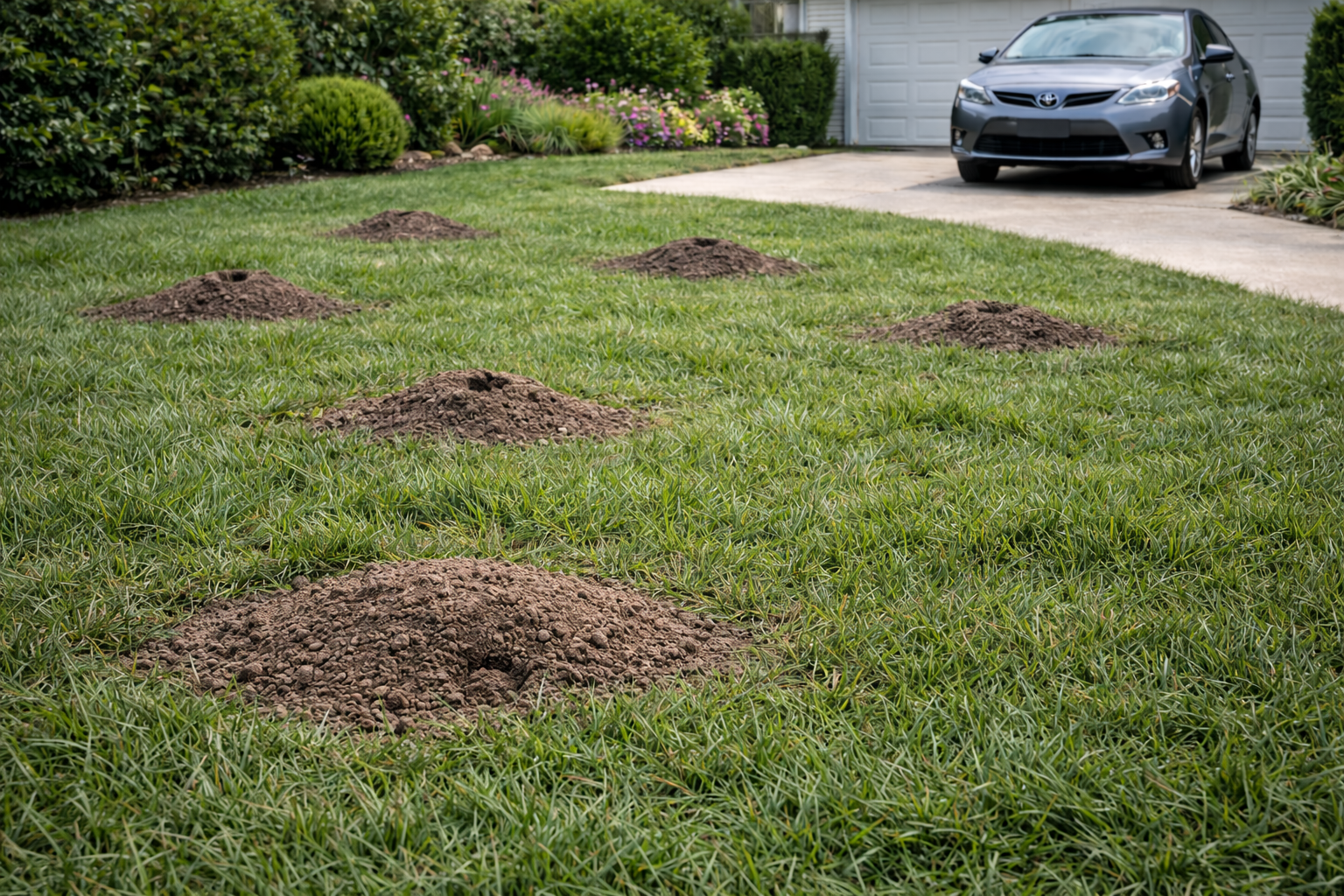
Identifying active gopher presence begins with recognizing characteristic mounds. Botta's pocket gophers create two distinct mound types: the crescent-shaped or horseshoe-shaped mound formed when gophers push soil directly upward while excavating from below, and the fan-shaped mound created as gophers push soil to the side. Individual mounds in Glendale yards typically measure 6 to 12 inches in diameter and 4 to 8 inches in height, though older, settled mounds may appear flattened.
Beyond surface mounds, gophers damage irrigation infrastructure extensively. Subsurface tunnels bisect drip irrigation lines and soaker hoses, reducing system efficiency and creating water waste. The gophers themselves do not consume the irrigation materials but their tunneling disrupts system function, forcing water to flow through broken lines into surrounding soil rather than reaching intended plantings.
Plant damage appears in multiple forms. Gophers clip roots and bulbs below the soil surface, causing sudden wilting or death of ornamental plants, vegetables, and turf. In Glendale's common landscaping schemes featuring roses, agapanthus, and ornamental shrubs, clipped roots represent the most significant damage mechanism. Above-ground, gophers may clip young plants at soil level while feeding on bark and shoots. Uneven settling of lawn and hardscape surfaces occurs as gophers create voids beneath, particularly problematic on Glendale sidewalks and driveways built over active tunnel networks.
Landscape Considerations for Glendale Properties
Glendale's landscaping aesthetic has traditionally emphasized water-demanding ornamental plantings typical of Southern California suburbs from the mid-twentieth century onward. Properties throughout established neighborhoods feature extensive turf lawns, flowering shrubs including roses, flowering perennials such as agapanthus and daylilies, and specimen trees. This predominant landscape style creates concentrated food sources and moisture conditions that strongly attract gopher populations. The shallow-rooted ornamental bulbs and tender perennials common in Glendale yards represent especially vulnerable plantings from a gopher perspective.
Conversely, hardscape features—concrete pathways, patios, and structures—present barriers to gopher tunneling, creating zones of reduced activity. Properties with extensive hardscape relative to planted areas experience lower gopher pressure. Glendale properties incorporating drought-tolerant native and adapted plants, such as California sage species, toyon, and manzanita, alongside reduced irrigation regimes, create less hospitable conditions for gopher populations, as these plants support fewer invertebrate prey species and require less frequent irrigation that would soften soil and facilitate tunneling.
The distribution of gopher pressure across Glendale correlates closely with landscape composition and irrigation practices. Intensively-irrigated properties in neighborhoods like Glenoaks and Verdugo Woodlands typically experience heavier gopher activity than properties with reduced landscaping and irrigation. Understanding these landscape-gopher relationships enables property owners to make informed decisions regarding both preventive management approaches and landscape design choices suited to Glendale's semi-arid climate and active gopher populations.
For professional gopher control in Southern California, visit Rodent Guys — serving Los Angeles, Orange, San Bernardino, and Riverside counties.