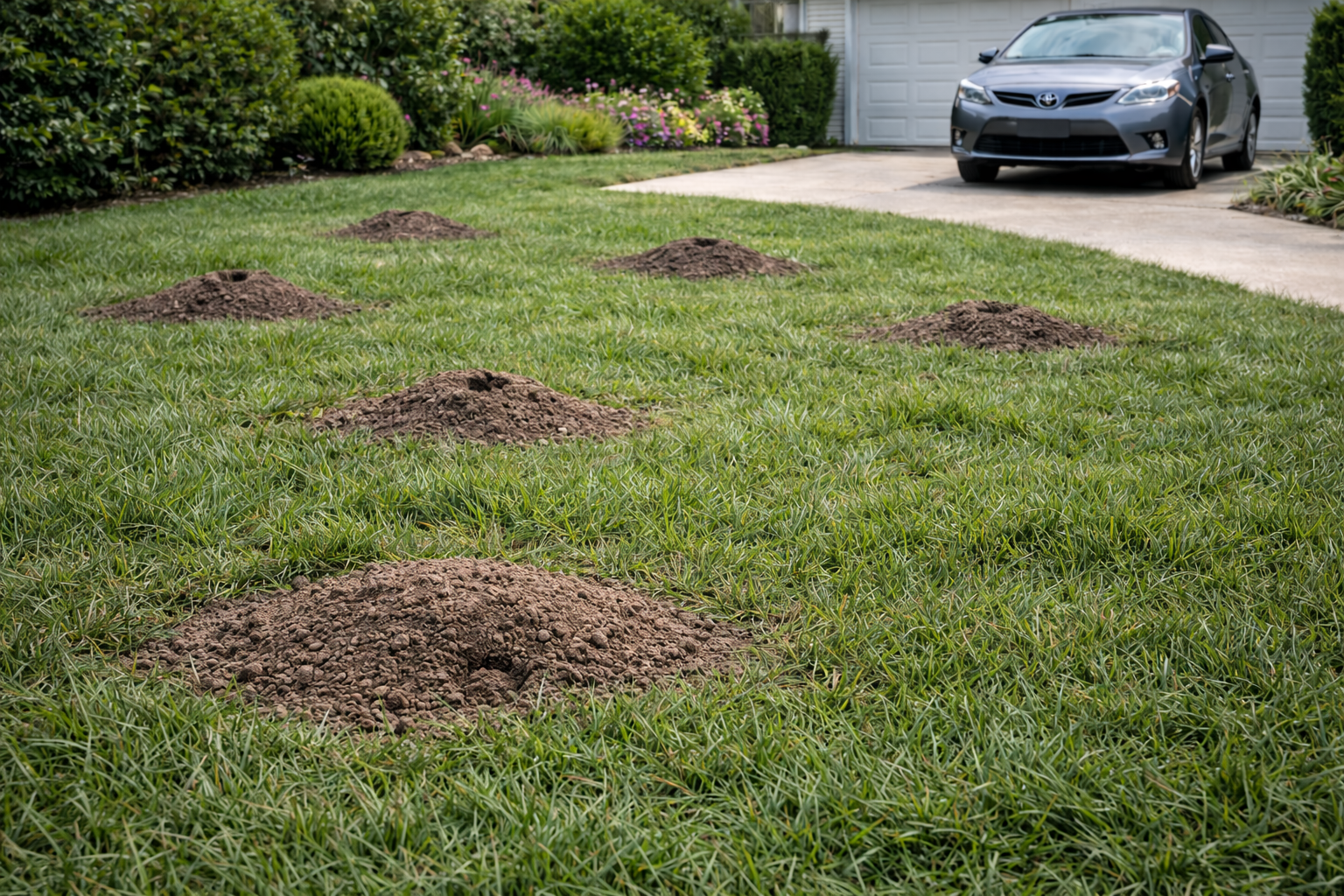
Gopher Activity in Porter Ranch, CA
Porter Ranch, a master-planned community in the northern San Fernando Valley region of Los Angeles, experiences consistent and sometimes intense gopher activity throughout the year. The combination of irrigated residential landscapes, favorable soil conditions, and proximity to undeveloped hillside areas creates an environment where pocket gophers thrive. Property owners in this community frequently encounter evidence of gopher tunneling systems that can compromise yards, damage irrigation infrastructure, and weaken plant root systems across both established neighborhoods and newer developments.
Why Porter Ranch Has Significant Gopher Activity
Porter Ranch's geography and environmental conditions make it particularly suitable for pocket gopher populations. The community sits in the northwest portion of the San Fernando Valley, with elevation changes ranging from approximately 800 to 2,000 feet as terrain transitions toward the Santa Susana Mountains to the north. This topographical variation creates diverse soil compositions, including sandy loam and silty loam soils that pocket gophers find ideal for tunneling—these soil types are soft enough to excavate but stable enough to maintain tunnel structure.
The extensive irrigation infrastructure throughout residential neighborhoods presents another significant factor. Most Porter Ranch properties maintain landscaped yards with irrigation systems designed to support the semi-arid climate of the San Fernando Valley, where annual rainfall averages approximately 15 inches, concentrated primarily between November and March. This consistent irrigation creates moist soil conditions that gophers actively seek, as moisture content facilitates both tunneling and increases the availability of succulent plant roots. Additionally, Porter Ranch's proximity to the Santa Susana Mountains and undeveloped open spaces provides a natural reservoir population of gophers, allowing continuous reinfestation of residential areas as animals disperse from wild habitat boundaries. The community's mix of mature landscaping in established sections and newer plantings in recent developments ensures abundant food sources year-round.
Common Gopher Species in Porter Ranch
The pocket gopher species dominant throughout Porter Ranch and the greater Los Angeles basin is the Botta's pocket gopher (Thomomys bottae), a burrowing rodent well-adapted to the regional climate and soil conditions. These animals typically measure 5 to 7 inches in body length, with relatively short, hairless tails that rarely exceed 2 inches. Their coloration ranges from brown to grayish-brown, and they possess powerful front legs equipped with claws specifically evolved for soil excavation. The name "pocket" gopher derives from externally opening cheek pouches that these animals use to transport food and nesting materials through their tunnel systems.
Botta's pocket gophers are solitary, territorial animals except during breeding season, meaning individual burrow systems typically support one adult gopher. Each animal maintains an extensive network of tunnels that can extend 100 to 200 feet or more, with multiple levels serving different purposes: shallow feeding tunnels near the surface where gophers locate plant roots and bulbs, and deeper refuge chambers where the animal nests and stores food. In Porter Ranch yards, this burrowing behavior directly impacts residential landscaping. The species is native to California and has occupied the San Fernando Valley landscape for millennia, but the conversion of natural grassland and chaparral habitat to irrigated residential and agricultural landscapes has substantially increased local population densities by providing both ideal burrowing substrate and abundant food resources through ornamental plantings.
When Gopher Activity Peaks in Porter Ranch
Gopher activity in Porter Ranch exhibits distinct seasonal patterns tied to breeding cycles and environmental moisture conditions. The primary breeding season occurs from January through March, during which male gophers actively disperse seeking mates, resulting in increased surface activity and new burrow construction. This period coincides with the San Fernando Valley's wettest months, when winter rainfall naturally moistens soil and triggers emergence of vegetation—conditions that make tunneling easier and food more abundant. During these months, property owners frequently notice fresh mounding activity in previously stable yards as young gophers establish new territory and established animals expand existing burrow systems.
Secondary peaks in activity occur during spring months (April and May) as remaining juvenile gophers finalize territorial establishment and as spring irrigation cycles begin in earnest across Porter Ranch neighborhoods. Summer activity (June through August) generally decreases somewhat, though gophers remain active in areas receiving consistent irrigation. In contrast, fall months (September through November) show reduced surface evidence as soil moisture naturally declines and gophers concentrate in deeper tunnels accessing stored food and relying on moisture from plant roots. Throughout all seasons, however, the year-round irrigation systems maintained across Porter Ranch provide continuous water availability that sustains population activity even during naturally dry periods. Property owners should anticipate that seasonal management efforts prove most effective during winter and early spring months when gophers are most active and populations are most mobile.
Signs of Gopher Damage in Porter Ranch Yards
The most visible indicator of gopher presence consists of characteristic mounding—small to medium-sized soil mounds appearing in lawns and landscape beds, typically 6 to 12 inches in diameter and 2 to 6 inches in height. These mounds result from surface soil displacement during tunnel excavation and maintenance. In Porter Ranch's typical residential yards, mounding patterns often align with landscape features, appearing in linear patterns along irrigation lines or clustering near planted beds where root systems provide concentrated food sources. Mound identification proves critical: gopher mounds are crescent or horseshoe-shaped with a plug of soil visible in the center, distinctly different from the more uniform, cone-shaped mounds created by moles (which rarely occur in the San Fernando Valley).
Beyond surface mounding, gopher activity causes subsurface irrigation damage that may not become apparent until significant harm occurs. The extensive burrow networks intersect underground irrigation lines, leading to leaks that waste water and potentially cause localized flooding or erosion. Property owners may notice soggy patches in previously well-drained areas, or they may encounter failed irrigation zones serving portions of landscaped areas. Plant damage patterns also reveal gopher presence—young trees and shrubs may be girdled at the base or below ground level as gophers feed on bark and roots, causing sudden wilting or death. Vegetable gardens and ornamental plantings experience root severing and bulb removal, with plants appearing healthy one week and dying the next as root systems are consumed. In established lawns throughout neighborhoods like the Trails at Porter Ranch or near the community's central parks, gopher activity creates soft, unstable ground that poses tripping hazards and aesthetic degradation.
Landscape Considerations for Porter Ranch Properties
Porter Ranch's landscaping aesthetic and plant choices significantly influence gopher activity patterns and damage severity. The community's master-planned design generally emphasizes water-wise landscaping incorporating native and drought-tolerant species, though many properties maintain mixed landscapes combining succulents, shrubs, and turf areas. Certain ornamental plants common throughout Porter Ranch neighborhoods prove particularly attractive to gophers: young fruit trees (citrus, stone fruits), herbaceous perennials including salvia species, and newly planted shrubs with tender root systems all experience heavy gopher predation. Conversely, established trees with mature, woody root systems and certain aromatic plants (Russian sage, lavender, catmint) experience less damage, allowing property owners to make informed landscaping decisions that may reduce gopher attractiveness.
The proportion of softscape (planted areas) versus hardscape (patios, walkways, structures) influences overall gopher presence. Properties with extensive hardscaping and minimal planted areas support lower gopher populations simply because food sources and suitable burrowing habitat are limited. In contrast, yards with generous turf areas, multiple planted beds, and comprehensive irrigation systems provide ideal conditions for gopher establishment and population growth. Porter Ranch's original master plan incorporated significant open space areas and parkway landscaping, particularly along streets like Sesnon Boulevard and Rinaldi Street, creating corridors where gopher populations concentrate and from which animals continuously disperse into adjacent residential properties. Understanding these landscape dynamics allows property owners to make informed decisions about yard design, plant selection, and irrigation methods that balance aesthetic and functional goals with practical consideration of gopher ecology and behavior.
For professional gopher control in Southern California, visit Rodent Guys — serving Los Angeles, Orange, San Bernardino, and Riverside counties.