Complete Gopher Removal Guide for Southern California
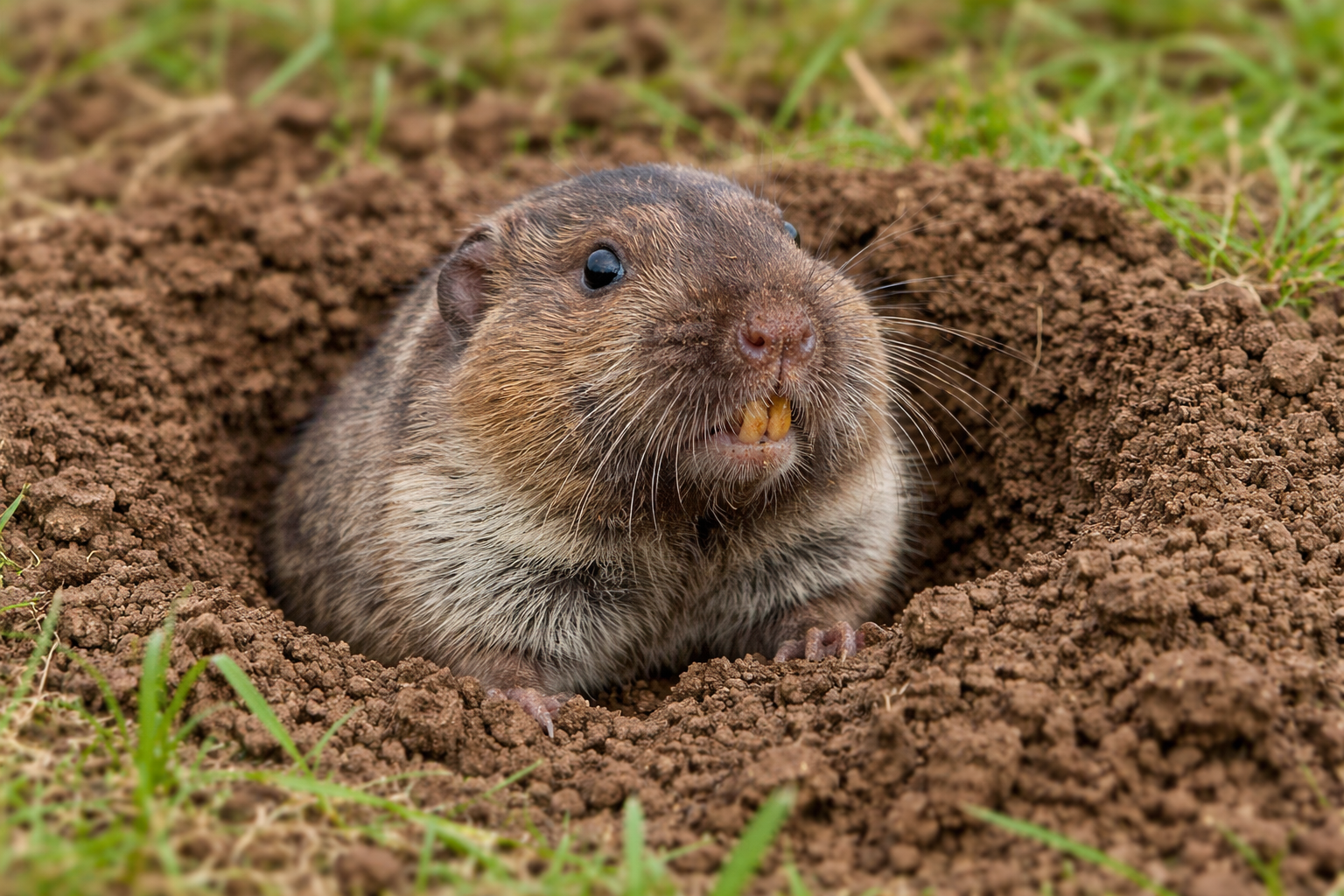
Pocket gophers are one of the most destructive yard pests in Southern California. A single gopher can dig 200+ feet of tunnels, destroy irrigation lines, kill trees, and turn a lawn into a minefield of dirt mounds — often within weeks of moving in.
Signs You Have a Gopher Problem
The most obvious sign is fresh fan-shaped or crescent-shaped dirt mounds in your yard. The plug (entrance hole) is usually visible on one side. Other signs include dying plants with intact stems (gophers eat roots underground), severed irrigation lines, and tunnels that collapse underfoot.
Why Gopher Removal Is Urgent
A single gopher establishes a territory of 200-2,000 square feet. Females produce 2-3 litters per year with 5-6 pups each. Left untreated, a single gopher problem can become a colony problem within one season. Gopher activity peaks in spring (March-May) and fall (September-November) in Southern California.
Most Effective Removal Methods
Underground trapping is the gold standard. Traps placed directly in active main tunnels target the specific gopher causing damage. A professional gopher exterminator locates the tunnel system, sets traps correctly, and returns within 24-48 hours.
What doesn't work: Vibration stakes, noise devices, and repellents are largely ineffective. Poison bait is effective but dangerous to pets, raptors, and children — and restricted near schools and water sources throughout Southern California.
Cost of Professional Gopher Removal
Professional gopher exterminator service in Southern California ranges from $100-$400 for initial treatment depending on property size. Monthly maintenance starts around $65-$85. Most properties with persistent pressure find recurring service most cost-effective. All Rodent Guys service includes a service guarantee.
Complete Step-by-Step Professional Removal Process
Step 1 — Probe and locate the main tunnel. The technician uses a soil probe near fresh mound activity, feeling for the characteristic sudden drop that indicates a tunnel void. Main tunnels run at consistent depth (typically 12-18 inches) in roughly straight lines between feeding areas; lateral tunnels branch off shorter distances and change direction frequently.
Step 2 — Distinguish main runway from lateral feeding tunnel. Main runways show consistent depth and continuous tunnel void over long distances. Lateral tunnels dead-end quickly or branch repeatedly. Placing traps in the main runway is roughly 5-10 times more effective than in laterals because the gopher passes through the main runway multiple times per day.
Step 3 — Set traps in pairs at correct depth and direction. Traps are placed in pairs facing opposite directions in the tunnel, ensuring the gopher encounters a trap regardless of travel direction. Depth is precisely matched to tunnel center, and tunnel is left partially open to allow air movement (gophers close off tunnels they detect as blocked).
Step 4 — Check and reset every 5-7 days. Captured gophers are removed and documented. Empty traps are reset, relocated, or left in place depending on new mound activity patterns.
Step 5 — Clearance confirmation. When no new mound activity appears for one full check cycle, the property is declared clear. Standard turnaround: 2-4 weeks for typical residential properties; 4-6 weeks for large or canyon-adjacent properties.
Best Time of Year for Gopher Trapping in Southern California
Trapping is effective year-round in SoCal because gophers don't experience true winter dormancy here. That said, two windows produce slightly better success rates: Spring (March-May) when gopher activity peaks as females produce litters and juveniles disperse to establish new territories — trapping during dispersal prevents colony expansion. Fall (September-November) when soil moisture returns after summer dryness and gopher activity intensifies again. Winter trapping also works well because moist soil reveals mound activity clearly and gophers are consistently using established primary runways.
How Many Traps Per Gopher?
A single gopher territory typically requires 2-4 traps placed in pairs at 2-3 locations along the main runway. Larger territories or properties with multiple gophers scale proportionally — a typical single-family yard with one active gopher requires 4-6 traps. Oversetting (10+ traps) rarely improves outcome and can actually reduce success if traps are placed in wrong tunnel types.
After Removal — Burrow Collapse, Soil Repair, and Plant Replacement
Once the gopher is removed, the tunnel system gradually collapses under normal foot traffic and irrigation. Accelerate collapse by lightly packing down mounds with a rake or shovel back. For large tunnel systems, rolling the lawn with a lawn roller compresses remaining tunnels effectively. Plant replacement for gopher-killed plants can proceed immediately — install new plants with gopher wire baskets around the root ball if the area has chronic pressure. Irrigation repairs for chewed drip lines and damaged PVC can also proceed without waiting. Expect lawn areas to settle slightly for 2-3 months as tunnel systems compact; light top-dressing with soil corrects most settling.
When One Treatment Is Enough vs When Ongoing Service Is Needed
One-time treatment is sufficient when: the property has buffer from open space, active agriculture, and water corridors (no continuous reinvasion source). Interior neighborhood properties often stay clear for months after initial service.
Ongoing service (monthly or quarterly) is the right call when: the property borders wild land, hillside terrain, active agriculture, equestrian acreage, or a river/creek corridor. These conditions produce continuous reinvasion that one-time treatment cannot hold against. Monthly maintenance intercepts new arrivals before they establish colonies; quarterly maintenance handles moderate external pressure.